
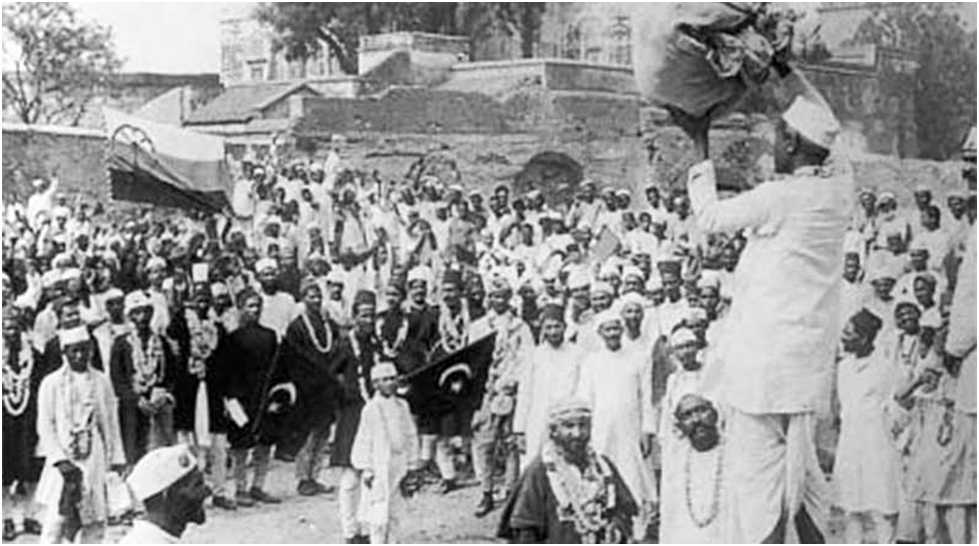
The Swadeshi and Boycott Movement began as a reaction to partition of Bengal which became known in 1903, was formally announced in July 1905 and came into force in October 1905. The motive behind partition was to weaken Bengal which was the nerve centre of Indian nationalist activity.
Must read: Impact of Swadeshi Movement on Freedom Struggle
Moderate-led anti-partition movement (1903–05) was under Surendranath Banerjea, K.K. Mitra, Prithwishchandra Ray. Methods included public meetings, petitions, memoranda, propaganda through newspapers and pamphlets.
The movement under Extremists (1905–08) was led by Tilak, Bipin Chandra Pal, Lajpat Rai, Aurobindo Ghosh. Methods included boycott of foreign cloth and other goods, public meetings and processions, forming corps of volunteers or samitis, use of traditional popular festivals and melas for propaganda, emphasis on self-reliance or atma shakti, launching programme of swadeshi or national education,
swadeshi or indigenous enterprises, initiating new trends in Indian painting, songs, poetry, pioneering research in science and later calling for boycott of schools, colleges, councils, government service, etc.
However, by 1908, the open phase (as different from the underground revolutionary phase) of the Swadeshi and Boycott movement was almost over. Despite its gradual decline into inactivity, the movement was a turning point in modern Indian history.
It proved to be a ‘leap forward’ in more ways than one:
● All the major trends of the national movement, from conservative moderation to political extremism, from revolutionary activities to incipient socialism, from petitions and prayers to passive resistance and non-cooperation emerged during the Swadeshi Movement.
● Hitherto untouched sections—students, women, workers, some sections of urban and rural population—participated.
● The richness of the movement was not confined to the political sphere, but encompassed art, literature, science, and industry also.
● People were aroused from slumber and now they learned to take bold political positions and participate in new forms of political work.
● The swadeshi campaign undermined the hegemony of colonial ideas and institutions.
● The future struggle was to draw heavily from the experience gained.
External link: https://en.wikipedia.org/wiki/Swadeshi_movement#:~:text=In%20response%20the%20Swadeshi%20movement,swaraj%20(self%2Drule).
