
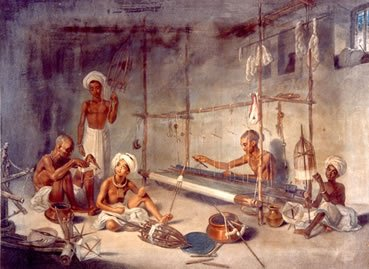
British rule in India caused a transformation of India’s economy into a colonial economy, i.e., the structure and operation of Indian economy were determined by the interests of the British economy.
One-Way Free Trade
Cheap and machine-made imports flooded the Indian market after the Charter Act of 1813 allowing one-way free trade for the British citizens.
On the other hand, Indian products found it more and more difficult to penetrate the European markets. Tariffs of nearly 80 per cent were imposed on Indian textiles so that Indian cloth could no longer be cheap. After 1820, European markets were virtually closed to Indian exports.
Cheap British-made cloth flooded the Indian market. The newly introduced rail network helped the European products to reach the remotest corners of the country.
From being a net exporter, India became a net importer.
No Steps towards Modern Industrialisation
The loss of traditional livelihood was not accompanied by a process of industrialisation in India, as had happened in other rapidly industrialising countries of the time.
This resulted in deindustrialisation of India at a time when Europe was witnessing a reintensified Industrial Revolution.
This happened at a time when Indian artisans and handicraftsmen were already feeling the crunch due to loss of patronage by princes and the nobility, who were now under the influence of new western tastes and values.
Ruralisation
Another feature of deindustrialisation was the decline of many cities and a process of ruralisation of India.
Many artisans, faced with diminishing returns and repressive policies (in Bengal, during the Company’s rule, artisans were paid low wages and forced to sell their products at low prices), abandoned their professions, moved to villages, and took to agriculture. This resulted in increased pressure on land.
An overburdened agriculture sector was a major cause of poverty during British rule and this upset the village economic set-up.
Must read: How British policies impacted the major resources of the tribals?
External link: https://en.wikipedia.org/wiki/De-industrialisation_of_India
