
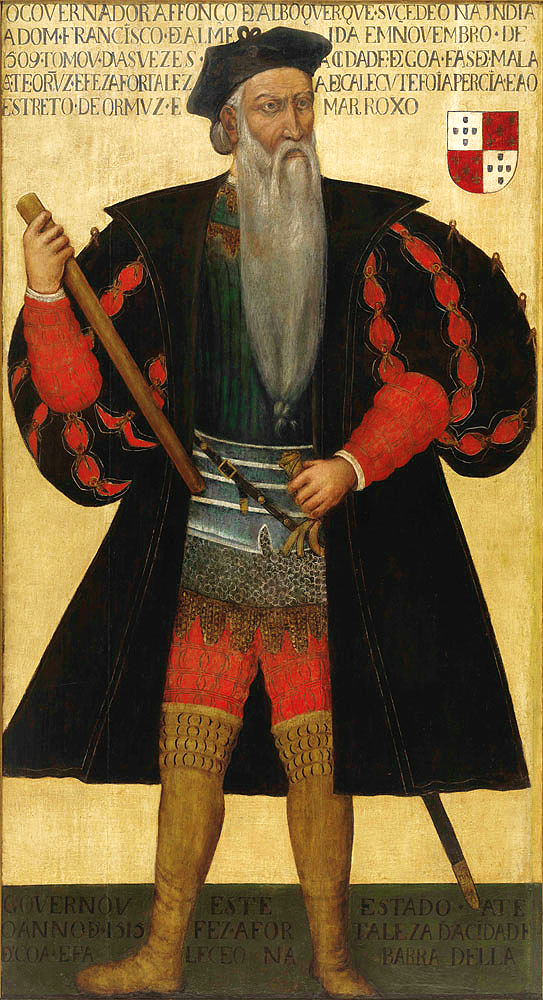
Albuquerque (Portuguese governor in India) was the real founder of the Portuguese power in the East, a task he completed before his death.
He secured for Portugal the strategic control of the Indian Ocean by establishing bases overlooking all the entrances to the sea.
There were Portuguese strongholds in East Africa, off the Red Sea, at Ormuz; in Malabar; and at Malacca.
The Portuguese, under Albuquerque bolstered their stranglehold by introducing a permit system for other ships and exercising control over the major ship-building centres in the region.
The non availability of timber in the Gulf and Red Sea regions for ship-building also helped the Portuguese in their objectives.
Albuquerque acquired Goa from the Sultan of Bijapur in 1510 with ease; the principal port of the Sultan of Bijapur became “the first bit of Indian territory to be under the Europeans since the time of Alexander the Great”.
An interesting feature of his rule was the abolition of sati.
Must read: Decline of the Portuguese rule in India
Significance of the Portuguese rule in India
External link: https://en.wikipedia.org/wiki/Afonso_de_Albuquerque
PRACTICE QUESTIONS
QUES . With reference to Indian history, consider the following statements: UPSC 2022
1 . The Dutch established their factories/warehouses on the east coast on lands granted to them by Gajapati rulers.
2 . Alfonso de Albuquerque captured Goa from the Bijapur Sultanate.
3 . The English East India Company established a factory at Madras on a plot of land leased from a representative of the Vijayangara empire.
Which of the statements given above are correct?
(a) 1 and 2 only
(b) 2 and 3 only
(c) 1 and 3 only
(d) 1, 2 and 3
Ans (b) EXPLANATION: ֍ The Hindu Gajapati rulers (c. 1435 – 1541 CE) ruled over Kalinga (Odisha), large parts of Andhra Pradesh and West Bengal, and the eastern and central parts of Madhya Pradesh and Jharkhand. ֍ Gajapati means “king with an army of elephants”. ֍ In c. 1435 CE, Kapilendra Deva founded the Gajapati dynasty and last ruler of this dynasty was Prataparudra Deva who ruled till 1540 CE. ֍ In 1602, the United East India Company of the Netherlands was formed and given permission by the Dutch government to trade in the East Indies including India. ֍ The Dutch founded their first factory in Masaulipatam in Andhra Pradesh in 1605. ֍ Thus the Dutch came much later than during the time of Gajapati rulers (c. 1435 – 1541 CE). Hence statement 1 is not correct. ֍ Albuquerque acquired Goa from the Sultan of Bijapur in 1510 with ease. Hence statement 2 is correct. ֍ British’s East India Company established a factory in Madras in 1639 on land leased from representatives of Vijayanagara Empire called the Nayakas. Hence statement 3 is correct.
