
QUES . Discuss the reasons for the decline of the Indus Valley Civilization in the beginning of the 2nd Millennium BC. UPSC IES/ISS EXAM 2014 General Studies. 200 Words. 5 Marks.
HINTS:
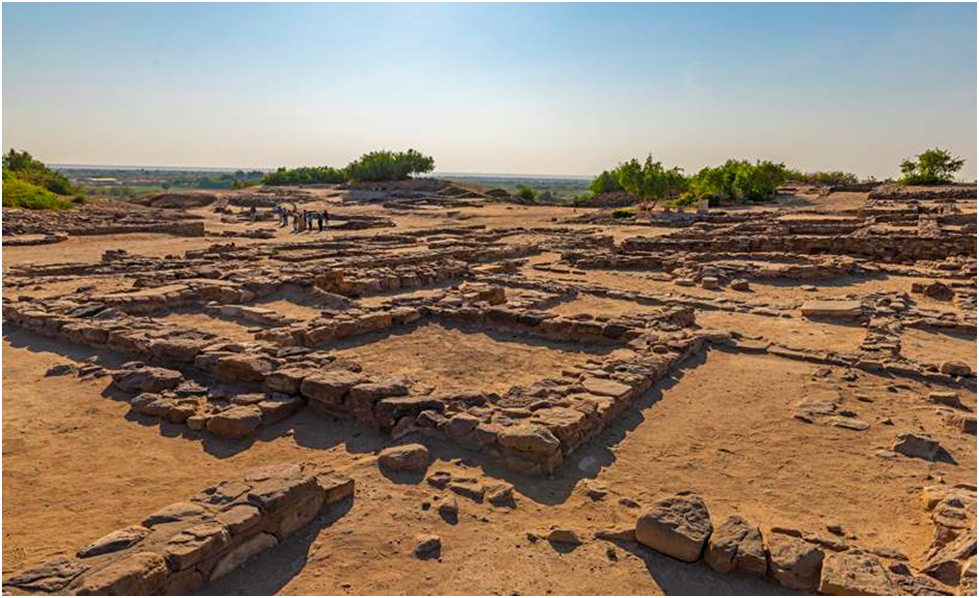
By 1800 BCE most of the mature Harappan sites were abandoned. The expansion of population and its migration took place towards Gujarat, Haryana, Western U.P etc.
After 1900 B.C. sites which existed marked the transformation of material culture i.e. disappearance of distinctive artefacts of civilization like weights, seals, distant trade, etc. Writing, long-distance trade, and craft specialization also disappeared. House construction techniques deteriorated and large public structures were no longer produced. This indicates a rural way of life named late Harappan.
Various theories have been propounded with respect to the decline of the Indus Valley Civilization:
Aryan Invasion Theory
It was propounded by Max Mueller and Mortimer Wheeler. According to this theory, an invasion by the Aryan people, who came from the north and brought with them new technologies and ideas, led to the collapse of the existing civilization.
Environmental Factors and Climate change
According to Robert Raikes and R.D. Oldham environmental factors, such as climate change, drought, and floods, played a major role in the decline of the Indus Valley Civilization.
Shifting monsoon patterns linked to climate change likely caused the rise and fall of the ancient Indus Valley Civilisation. Climate change → weaker monsoons → reduced water supply → gradual drying of the soil → scattering of population eastward and southward.
Internal Decline
According to S.R. Rao, the decline of the Indus Valley Civilization was caused by internal factors such as political instability, corruption, and economic decline.
Natural Disaster Theory
This theory was propounded by D.P. Agrawal. It suggests that a major natural disaster, such as an earthquake, was responsible for the decline of the Indus Valley Civilization.
Integration with Vedic Culture
According to David Frawley, the decline of the Indus Valley Civilization was not a collapse but rather a transformation into the Vedic culture of ancient India.
Shifting Away of the Indus
Lambrick has offered his own explanation for the decline. He believes that changes in the course of the river Indus could be the cause of the destruction of Mohenjodaro. Indus shifted about thirty miles away from Mohenjodaro. The people of the city and the surrounding villages, deserted the area because they were starved of water.
A recent finding titled ‘Neoglacial climate anomalies and the Harappan metamorphosis’, done by an international team of scientists has suggested climate change as the possible reason for the decline of the Indus Valley Civilisation. Changes in temperature and precipitation led to the decline of monsoon and drying up of the Ghaggar-Hakra River. This led to a decline in crop and urban Harappan society turning rural.
Must read: Mohenjo-daro : an example of a planned urban centre
Urban planning and culture in the Indus Valley Civilisation
Architecture of the Indus Valley Civilization
Lessons from the urban planning and cultural aspects of Indus Valley Civilisation
External link : https://egyankosh.ac.in/bitstream/123456789/20132/1/Unit-9.pdf
