
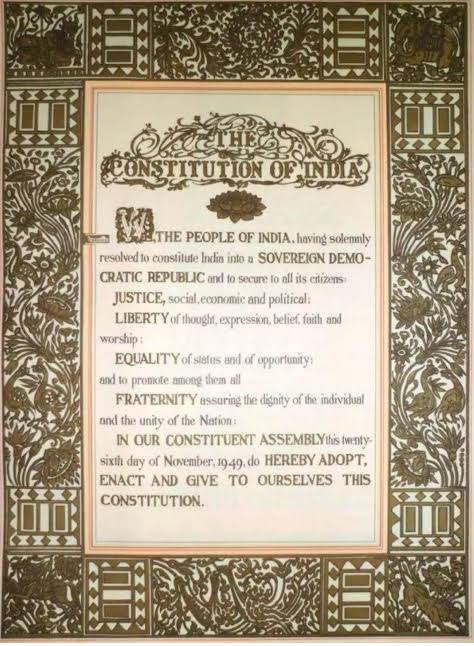
QUES. The Preamble of the Constitution of India is not just the declaration of its ideals, but it represents the foundational philosophy of the Republic. Examine the statement. UPSC IES/ISS EXAM 2026. General Studies. 200 Words. 5 Marks.
HINTS:
Derived from Pandit Jawaharlal Nehru’s “Objectives Resolution”, Preamble of the Indian Constitution declares India to be a Sovereign, Socialist, Secular and Democratic Republic. However, the Preamble is not just the declaration of its ideals, but it represents the foundational philosophy of the Republic.
Must read: “The Preamble is the key to the whole constitution”
The Preamble is the guiding philosophy of the Indian Constitution. It establishes the ultimate source of power (the people) and sets the nation’s core objectives. Furthermore, it provides an interpretive framework for the judiciary when constitutional ambiguities arise.
Preamble as a Foundational Philosophy
The Preamble transcends being a mere list of objectives; it embodies the sociopolitical and economic ethos of the Republic. Its foundational elements can be understood through two main aspects:
Nature of the Indian State
The Preamble outlines five core attributes of the nation:
Sovereign: India is independent from external control, both internally and externally.
Socialist: Ensures equitable distribution of resources and the eradication of socioeconomic inequalities.
Secular: Guarantees equal respect, protection, and state support for all religions.
Democratic: Power stems from the will of the people, exercised through universal adult franchise and regular elections.
Republic: The head of the state is an elected individual, not a hereditary monarch.
Objectives of the Republic
The core philosophy is further established through the four pillars of sociopolitical transformation:
Justice: Social, economic, and political justice ensures that the marginalized are protected and society remains egalitarian.
Liberty: Freedom of thought, expression, belief, faith, and worship allows citizens to develop their full potential.
Equality: Eliminating discrimination based on status and opportunity creates a level playing field.
Fraternity: A sense of brotherhood that preserves the dignity of the individual while maintaining the unity and integrity of the nation.
Significance of the Preamble
Preamble of the Indian Constitution is far more than a declaration of ideals. Its multifaceted role includes
Interpretive significance
Over decades of landmark rulings, the judiciary has elevated it to the core of India’s legal framework. The Supreme Court of India recognized the Preamble as a legitimate aid in statutory and constitutional interpretation.
The Supreme Court relies on it as a moral compass and interpretative tool to resolve ambiguities in constitutional provisions and laws. Landmark cases—such as the Kesavananda Bharati case (1973)—have established that the Preamble reflects the “basic structure” of the Constitution. Therefore, while it is not directly enforceable in a court of law on its own, no legislative or constitutional amendment can alter the foundational philosophy embedded within it.
Source of authority
Beginning with “We, the people of India,” it establishes that all constitutional power derives directly from the citizens.
The “Basic Structure”
In the historic Kesavananda Bharati v. State of Kerala case (1973), the court ruled it is an integral part of the Constitution. This means it cannot be amended to alter the foundational features of the Indian state.
Fundamental Rights Linkage
It guides the state in securing social, economic, and political Justice, translating lofty ideas into enforceable Fundamental Rights and Directive Principles.
Thus, the Preamble of the Indian Constitution serves as its foundational philosophy, encapsulating the vision of the Constituent Assembly. It establishes the source of the Constitution’s authority (“We, the people”), defines the nature of the Indian state, and outlines the core ideals of justice, liberty, equality and fraternity.
