
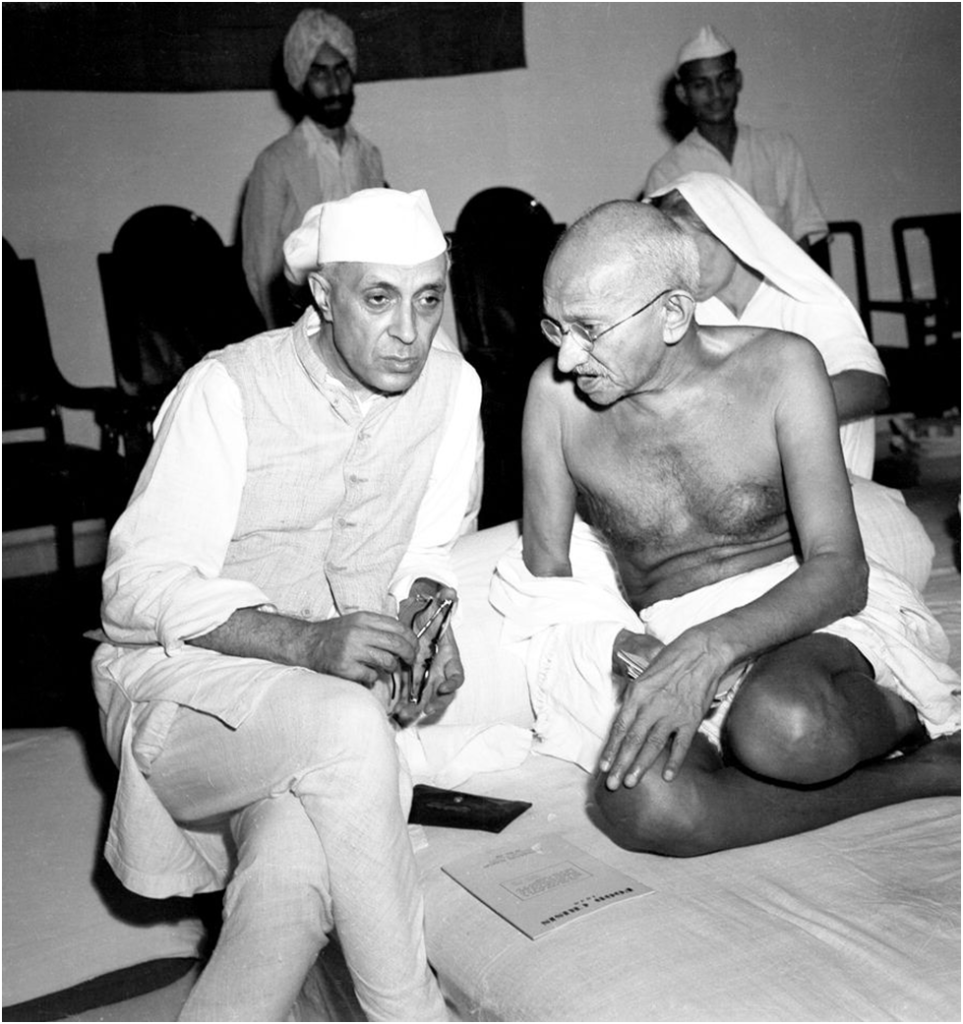
When Gandhi designated Nehru as his chosen successor?
The Congress leaders, released in December 1941, in the midst of Japan’s aggressive actions, were anxious to defend Indian territory and go to the aid of the Allies. The Congress Working Committee overrode Gandhi’s and Nehru’s objections and passed a resolution offering to cooperate with the government in the defence of India, if:
(i) full independence was given after the war, and
(ii) substance of power was transferred immediately.
It was at this time that Gandhi designated Nehru as his chosen successor.
What were the differences and similarities between Nehru and Gandhi?
Nehru and Gandhi differed in temperament and attitudes towards modernity, religion, God, State, and industrialisation.
Nehru was indifferent to religion, Gandhi believed deeply in his own version of God; Nehru believed that industrialisation was the only solution to the acute and widespread poverty of India, while Gandhi called for the reviving of the rural economy.
Nehru believed in the powers of the modern State to elevate and reform society, while Gandhi was sceptical of State power, trusting instead to the conscience and willingness of individuals and communities.
Despite having so many differences, Nehru revered Gandhi, and Gandhi, in turn, believed in Nehru more than his own sons.
Both teacher and disciple had fundamental similarities—patriotism in an inclusive sense, i.e., they identified with India as a whole rather than with a particular caste, language, region, or religion. Both believed in non-violence and democratic form of government.
Why Gandhi preferred Nehru to the alternatives?
Rajmohan Gandhi, in his book, The Good Boatman, writes that Gandhi preferred Nehru to the alternatives because he most reliably reflected the pluralist, inclusive idea of India that the Mahatma himself stood for. The alternatives—Patel, Rajaji, Azad, Kripalani, Rajendra Prasad—had somewhat sectional interests and affiliations.
But Nehru was a Hindu who could be trusted by Muslims, a north-Indian who was respected in south India, and a man who was admired by women. Like Gandhi, Nehru was genuinely an all-India leader, who gave Indians hope—that they could build a more prosperous and peaceful society.
Must read: Many voices had strengthened and enriched the nationalist movement during the Gandhian phase
External link: https://www.telegraphindia.com/culture/books/jawahar-will-be-my-successor-mahatma-gandhi/cid/1719284
