
QUES. What role did the INA trials play in facilitating the process of Indian Independence?
HINTS:
The INA (Indian National Army) trials, held between 1945-1946, were a watershed moment in India’s freedom struggle, significantly accelerating the process of Indian independence. These trials, conducted at the Red Fort, involved prominent INA officers such as Shah Nawaz Khan, Prem Kumar Sehgal, and Gurbaksh Singh Dhillon, who were charged with treason, murder, and abuse of military laws under British rule.
Must read: INA Trials
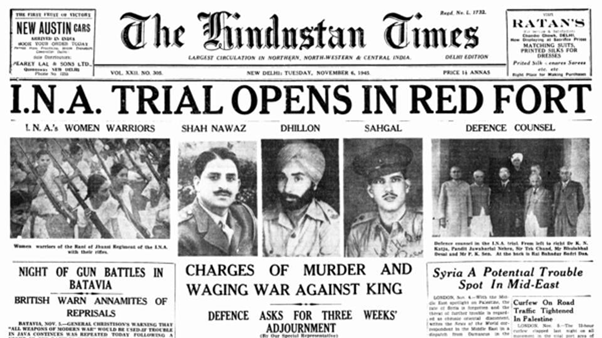
The trials attracted massive public attention and sparked a nationwide wave of protest and solidarity, cutting across religious and regional lines. The fact that these men had fought not for personal gain but for the liberation of India inspired millions and shattered the colonial narrative that loyalty to the British crown was synonymous with patriotism.
Must read: Role of Indian National Army (INA) in the freedom struggle of India
Importantly, the trials galvanized nationalist sentiments and revitalized anti-colonial activism, even among previously indifferent sections of the population. Leaders of the Indian National Congress, including Jawaharlal Nehru, took an active role in defending the accused, signaling a unified front against British injustice.
As there were Hindus, Muslims and Sikhs in the INA who had fought as Indians, the struggles of the INA demonstrated that those who waged an armed struggle against the British were not at all affected by communal division.
The most profound impact of the INA trials was seen within the ranks of the British Indian military. Widespread mutinies in the Royal Indian Navy and unrest in the army and air force, largely influenced by the public support for the INA, alarmed the British administration. Realizing the potential collapse of its armed forces, Britain acknowledged that continuing to rule India was no longer feasible.
In essence, the INA trials transcended the courtroom and became a symbol of resistance, uniting the nation and undermining British authority—thereby catalyzing the final push towards Independence in 1947.
